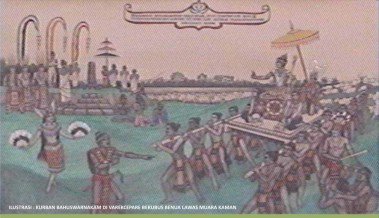
Starting from the reign of the Sagara Kingdom which used to be the power of the Malayan Kingdom which in the Yupa inscription was called Pravatam Sadiva Malaya which in the early centuries AD was led by a King named Tahani during the reign of the VIth Tahani namely Maharaja Sri Kundungga had a son-in-law named Prince Wangsekerta son of the 8th King of Salakanegara who was the adopted son of Sri Maharaja Kudungga and the Prince was a cousin of Maharaja Sri Kundungga himself. Their mothers were still siblings and Prince Wangsakarta was married to Maharaja Kundungga's daughter named Putri Gari and these two people inherited the kingdom of Sadiva Malaya After ascending the throne, Prince Wangsekerta had the title of Maharaja Aswawawarman and his wife had the title of Maharatu Sri Gari and his son-in-law, Maharaja Sri Kundungga, also built a royal state with the name of the Sagara Kingdom with its capital city or Kutanegara named Bakulapura from the name of Muara Kaman now, from this marriage three sons were born. The great ones who became senapati included Senapati Wangseragen, Senapati Wangseteku, Senapat Wangsejenjat. These three people would later rule the archipelago because these three people controlled the lands of Campa, Java and Kalimantan for the sacrifice they carried out, namely asmedha. The Sagara Kingdom was founded with the first ruler being the Maharaja Acwawarman because his 3 sons had conquered quite a large area so they were called the rulers of Nusa and Sagara (Nusantara), which consisted of islands and seas called Melenesia with their flag called Nira Ganda Wala or Red and White.
So that in 1635 AD this region fell and was under the rule of the VOC and the Dutch East Indies, England and Japan and in 1945 under the Republic of Indonesia, in 2001 AD this Kingdom was revived through the enactment of Customary Law and Culture and was given the name KUTAI MULAWARMAN KINGDOM with 50 generations of kings to date. The Sagara Kingdom was a Hindu kingdom in the archipelago which was the earliest kingdom in Indonesia. The Sagara Kingdom originated from a regional kingdom called Sadiva Malaya which was founded in 17 AD. The Sagara Kingdom embraced Hinduism and became a large country in the 4th century (around 400 AD) with evidence of the discovery of 7 Yupa-shaped Inscription Pillars in Muara Kaman, Kutai Kertanegara Regency, East Kalimantan, Indonesia. his kingdom is located in Muara Kaman, East Kalimantan, precisely at the head of the Mahakam river. The name Kutai is the name of an area called Quetaire which means vast wilderness because this kingdom has very large seas and land. Kutanegara is Bakulapura which means the meeting of two estuaries called Muara Kaman. The Yupa Stone and Yoni Stone and Lingga were built by the "Priest", which is now called the Yupa Inscription.The name Yupa is mentioned in inscriptions found that indicate the existence of a royal pedestal built in the 4th century. This religious culture entered Indonesia around the 2nd or 4th century, brought respectively by Wangsawarandewa traders and this Wangsa was a colony of Indian and Campa traders. In the life of dynasties or descendants of kings, traditions and ceremonies are still maintained so that from the culture of Belian Belian Tanah, Belian Semega, Belian Tujuh Buka Walu and the Sawai language, Indeed and Dondang and Dandeng and Neroyong The genealogy and customary laws are still being remembered from generation to generation, the last generation only recorded in 1997 and completed from 1999 to 2011, its genealogy has been registered in the register book of the Tenggarong District Court.
The era of the Sagara Kingdom began during the reign of Maharaja Aswawarman, then became famous during the reign of Maharaja Sri Mulawarman in the 4th century. Who is the grandson of Maharaja Sri Kundungga, who is Tahani as King of the Sadiva Malaya area.In this area, which developed during the reign of Maharaja Sri Mulawarman, the people lived in prosperity and felt at peace. Under VOC colonial rule, the political situation in the archipelago changed so that in 1635 the VOC wanted to control the Raja-raja region by means of war. Then, after the VOC colonial period and during the era of Indonesian independence, this kingdom was revived by the Government in an effort to preserve cultural traditions.
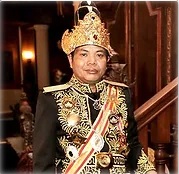
On 03 September 2001 to 09 September 2001. Located in Muara Kaman, CERAU was held, namely the Mulawarman Traditional Ceremony (UAM) called Rajasuja. This ceremony is the Ascension to the Throne of Maharaja Srinala Praditha Alpiansyah Rechza Fachlevie Wangsawarman (Prof. Dr. M.S.P.A Iansyah Rechza. F.W, Ph.D) Maharaja Kutai Mulawarman, the Great Ruler of Customary Law whose title is His Majesty the Sovereign Emperor of Kutai Mulawarman. As His Majesty Maharaja Srinila Karmila Perwati Dewi (Dr. M.S. Karmila., PD, Ph.D) As well as having the Crown Prince Maharaja Nala Indra Vachrucha Dilaya which was held at a ceremony on December 27 2017.